
I have always been fascinated by the subject of leadership.
Like many people, I have often looked at the challenges facing our communities, institutions, organisations, and nations and concluded that leadership lies at the centre of many of them. Over the years, this belief led me to study leadership extensively. Both my master’s and doctoral studies focused significantly on leadership, and during my doctoral work I expanded that interest to include governance.
Beyond formal education, I have had the privilege of engaging with people from different backgrounds through workshops, training programmes, conferences, classrooms, boardrooms, and countless informal conversations. These discussions have been some of the most enlightening parts of my journey.
One observation appeared repeatedly.
People often spoke passionately about leadership, yet many seemed to view leadership as something external rather than internal. Leadership was frequently associated with elected officials, chief executives, managers, pastors, teachers, or people occupying positions of authority. Leadership was something that belonged to “them.”
Very few people saw leadership as something that also belonged to “us.”
As a result, people were often quick to blame leaders, point fingers at institutions, and criticise those in authority, while rarely recognising their own responsibility or potential for leadership.
This fascinated me.
The more I reflected on these conversations, the more convinced I became that one of our greatest challenges is not necessarily the absence of leadership, but our understanding of what leadership truly means.
My own view differs from many of the assumptions I encountered.
I do not believe leadership is reserved for a special group of people.
I do not believe leadership begins when someone receives a title.
I do not believe leadership belongs only to those in positions of authority.
Instead, I believe leadership is a human capacity.
It is something that exists within all of us.
More importantly, I believe leadership is neutral.
Like fire, leadership can be used for good or for bad.
Fire can cook food and provide warmth. It can also destroy homes and cause harm. The power itself is neutral. What matters is how it is used.
Leadership is much the same.
Every person possesses the capacity to influence, guide, inspire, encourage, support, or direct others in some way. What determines whether that influence becomes positive or negative depends on character, values, choices, and purpose.
This is why I reject the common statement that certain individuals “were never leaders.”
My argument has always been different.
They may have been ineffective leaders.
They may have been unethical leaders.
They may have been destructive leaders.
But leadership itself is not automatically good or bad.
What people do with leadership determines whether it becomes a force for progress or a force for harm.
As I continued teaching, facilitating, and speaking on leadership, two comments appeared so frequently that I could no longer ignore them.
The first was:
“This should be taught at a much younger age.”
The second was:
“Do you have something that can help children understand leadership?”
Those questions keep coming.
The more I thought about them, the more I realised that many leadership programmes begin too late. By the time people attend leadership seminars, workshops, and executive training programmes, many of their habits, assumptions, attitudes, and beliefs have already been formed.
What if leadership formation started much earlier?
What if children learned that leadership begins with helping?
What if they learned that leadership is connected to listening?
What if they discovered that character matters more than popularity?
What if they understood that leadership begins before titles and positions arrive?
What if they learned that they cannot effectively lead others if they cannot first lead themselves?
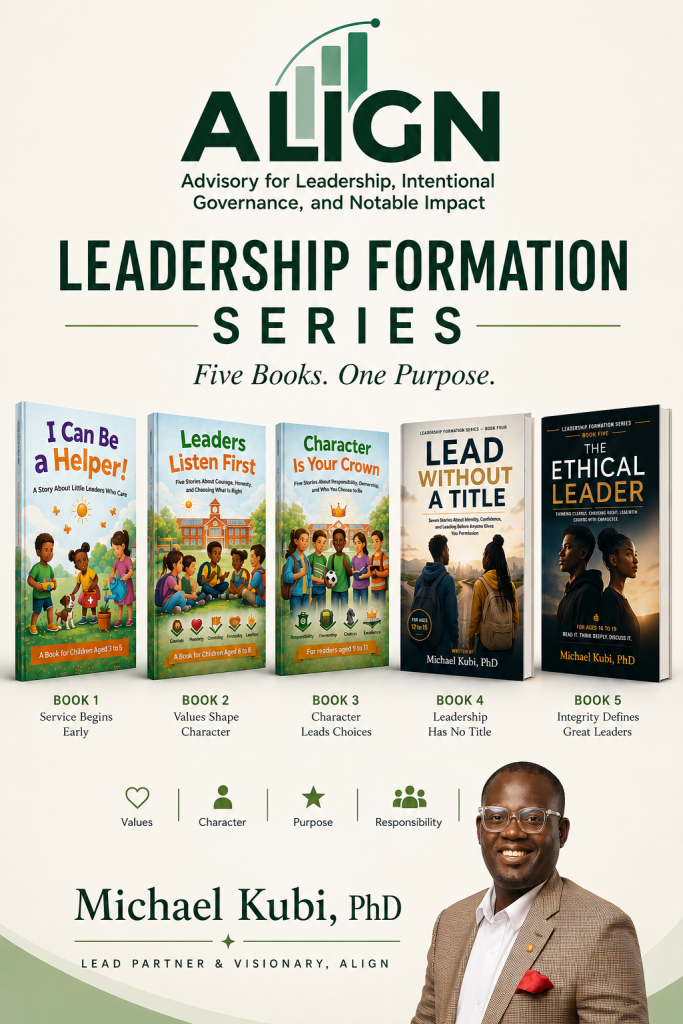
These questions eventually led to the creation of the ALIGN Leadership Formation Series.
The series began with a simple idea: leadership development should grow with the child.
A three-year-old should not receive the same lessons as a teenager. A teenager should not be taught leadership in the same way as a young adult. Yet the underlying principles remain connected.
The result is a five-book journey that follows children and young people from ages three to nineteen, introducing leadership concepts in ways that are appropriate for their stage of development.
The series begins with helping.
It grows through listening.
It develops through character.
It deepens through identity and self-leadership.
And it culminates in ethical leadership.
In many ways, writing these books has renewed my own passion for leadership. It has reminded me that leadership is not primarily about titles, positions, or authority. It is about responsibility, influence, character, and service.
Most importantly, it has reinforced my belief that meaningful change rarely begins with grand gestures.
It begins with ordinary people making better choices.
It begins with individuals accepting responsibility for their actions.
It begins with people understanding that leadership starts where they are, with what they have, and with the influence they already possess.
The change we hope to see in our families, communities, organisations, and nations will not come only from those at the top.
It will also come from millions of small decisions made by ordinary people every day.
That is why I wrote this series.
My hope is that it helps young people understand that leadership is not something they must wait for.
It is something they can begin practising now.
And this is only the beginning.
The ALIGN Leadership Formation Series will continue to grow. Additional volumes are already in development because leadership formation is a lifelong journey, not a destination.
I invite you to join that journey.
Together, we can help raise a generation that understands that leadership is personal, leadership is purposeful, and leadership begins within.
Michael Kubi, PhD
Lead Partner & Visionary, ALIGN