
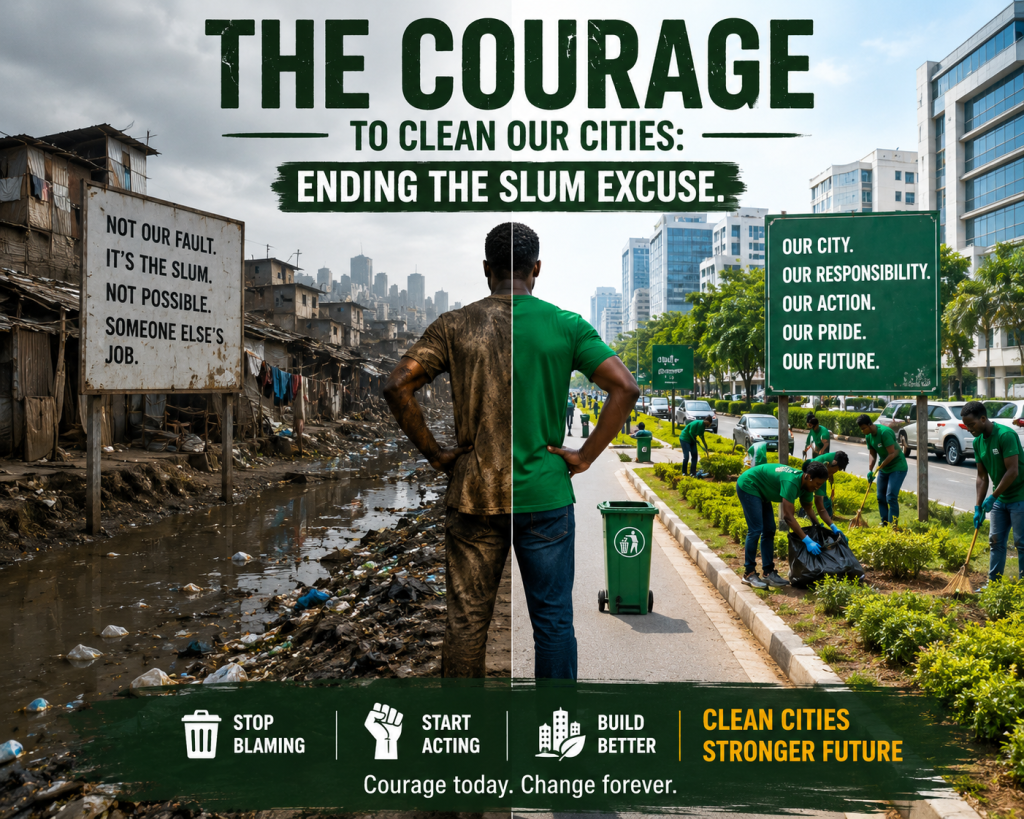
Every year, our cities grow more crowded, more disorderly, and more difficult to govern. Drive through almost any major town and you will see the same pattern repeating itself: informal settlements spreading into wetlands and reserved land, drains choked with refuse, pavements taken over by traders, and major markets spilling onto roads never designed to carry them. We have grown so accustomed to this disorder that we now treat it as normal, even inevitable.
It is neither.
For decades, we have allowed humanitarian language to shield us from an uncomfortable truth. We say we cannot act because the people affected are poor, and so every attempt to restore order to our cities is quietly abandoned out of sympathy. Compassion is a virtue. But compassion that permanently excuses lawlessness is not compassion. It is surrender dressed as kindness.
Slums are not simply unfortunate housing arrangements. They are, in most of our cities, the physical evidence of decades of unenforced planning law, unregulated settlement, and authorities unwilling to say no. They generate a disproportionate share of the filth, the flooding, the disease, and the disorder that our cities struggle with every year. When drains are blocked because structures were built directly over them, when refuse has nowhere organised to go because no planning authority was ever allowed to plan, the results are predictable. We should stop pretending they are not connected.
The same is true of the informal trading that has overrun our streets and major market areas. Pavements meant for pedestrians have become permanent shop fronts. Roads meant for traffic have become extensions of the market. Authorities look away because enforcing order feels harsh against people who are simply trying to survive. But the harm this disorder causes, congestion, accidents, fire risk, sanitation failures, is real, and it is borne by everyone, including the very people who can least afford another setback.
Jesus once said the poor will always be with us. That statement was never a licence for disorder. It was an honest acknowledgement that poverty is a permanent feature of human society, not an excuse to abandon standards because a person is poor. We can care for the poor and still insist that public land, public roads, and public safety are not negotiable. These are not contradictory positions. We have simply been unwilling to hold both at once.
What our cities need now is moral courage, not more studies, not more task forces that produce reports nobody implements, but authorities willing to enforce the planning laws already on the books. That means clearing settlements built illegally on waterways, reserved land, and drainage systems. It means removing structures and traders that have taken over streets and market perimeters that were never meant to hold them. It means doing this consistently, not selectively, so that enforcement is not seen as an attack on the poor but as the restoration of a standard that should never have been abandoned in the first place.
We know what happens when we continue to excuse this. We have watched it happen for years. The flooding returns every rainy season. The markets grow more chaotic. The slums expand further into land that will one day be needed for the infrastructure our growing populations require. Every year we delay, the cost of eventually correcting it grows larger, and the disorder becomes harder to reverse.
We either act now, deliberately and consistently, or we accept that this is simply how our cities will always be. I do not believe that is a future we should accept.
A fair account of the other side of this argument, and where I part ways with it
Any serious version of this position has to reckon honestly with what critics of slum clearance actually argue, because the objections are substantial and well documented. International guidance, including from UN-Habitat, holds that forced evictions carried out without adequate resettlement, compensation, or due process violate the right to housing and tend to push affected families into worse informal settlements rather than solving the underlying problem. Much of the research on informal settlements also points to structural causes rather than personal indiscipline: severe shortages of affordable formal housing, rapid rural-to-urban migration, and land markets that price the poor out of legal settlement options entirely.
I understand this position. I do not agree with it.
There is an important difference between a citizen whose legally owned land is taken by the state for public benefit, and a person who settled on land they had no right to occupy in the first place. The first case is a legitimate matter of compensation. When government acquires a person’s rightfully owned property for the good of the state, whether for roads, dams, or public infrastructure, that person deserves fair and prompt compensation. That is not in dispute.
The second case is different, and I think we do our societies a disservice when we treat the two as the same. Resettling and compensating people for occupying land illegally, simply because they have lived there long enough, does not solve the underlying disorder. It rewards it. It sends a clear signal to the next family considering the same choice: settle first, and the state will eventually be forced to accommodate you, perhaps even compensate you, for having broken the law. That is not justice. It is an incentive structure that guarantees the problem will keep repeating itself, because we have taught people that illegal settlement is eventually cost-free, or worse, eventually profitable.
Public funds are not without limits, and how we choose to spend them says something about what we are willing to tolerate. Money spent resettling people who knowingly or unknowingly built on land that was never theirs to build on is money that could have gone toward housing for citizens who followed the process, toward the infrastructure our cities actually need, or toward genuine social support for the poor delivered through legal, transparent channels. Compassion for the poor does not require the state to underwrite illegal occupation.
None of this removes the responsibility that comes before enforcement. Government still has an obligation to ensure enough affordable, legal housing exists, so that illegal settlement is not the only realistic option left to poor families. That is a fair criticism of many of our governments, and I accept it. But solving a housing shortage and rewarding illegal occupation are two different policy questions, and we should stop collapsing them into one. Build the housing. Enforce the law. Do not fund the very behaviour you are trying to end.