
In my last article, I argued that a rule against preaching and hawking in a moving vehicle is not an attack on the gospel. Several readers responded with a fair challenge: if the state is not the Church’s greatest problem, what is? I want to take up that question, carefully and without pretending to have every answer.
Let me start with people I know. Some of them have stopped attending church. The state did not stop them from worshipping God. No regulation closed a door against them. They left because of how they were treated by pastors and church leaders. Some felt exploited. Some were disappointed by the conduct of people they had trusted as spiritual guides. Others were hurt at the very moment they needed compassion, counsel or support.
Their experiences raise an uncomfortable question. Some church leaders are quick to describe government policy as an attack on Christianity. Are they giving the same energy to the people walking away from their own congregations?
A directive that restricts an activity may deserve scrutiny, and I have said so. But what do we call it when people withdraw from church, not under pressure from the state, but because they have lost confidence in its leaders? What do we say when those who should draw people closer to Christ become, through their conduct, a reason some choose to stay away?
I am not suggesting that everyone who leaves a church does so because of a pastor. People leave for many reasons, and many pastors serve their congregations faithfully, often at great personal cost. My concern is narrower. The hurt of those who have been disappointed should not be ignored while the Church concentrates on defending itself against the state.
The Church must care about its freedom to preach. It must care just as much about why some people no longer want to listen.
It is easier to blame the government than to confront failures within our own institutions. It is easier to organise a protest against a public directive than to admit the damage poor leadership can do to a person’s faith. No amount of public condemnation of the state can replace the trust that responsible Christian leadership has to build. The state has a duty to respect religious freedom, and any unjust restriction should be challenged. But the Church also has a duty to examine itself, and the language of persecution should not distract us from questions of accountability, pastoral conduct and the treatment of the people we claim to serve.
Which pastors are we talking about?
There is a second question, and I ask it as a question because I do not wish to accuse anyone without evidence. Which pastors are leading this protest, and how closely do their own arrangements reflect the concerns they say they are defending?
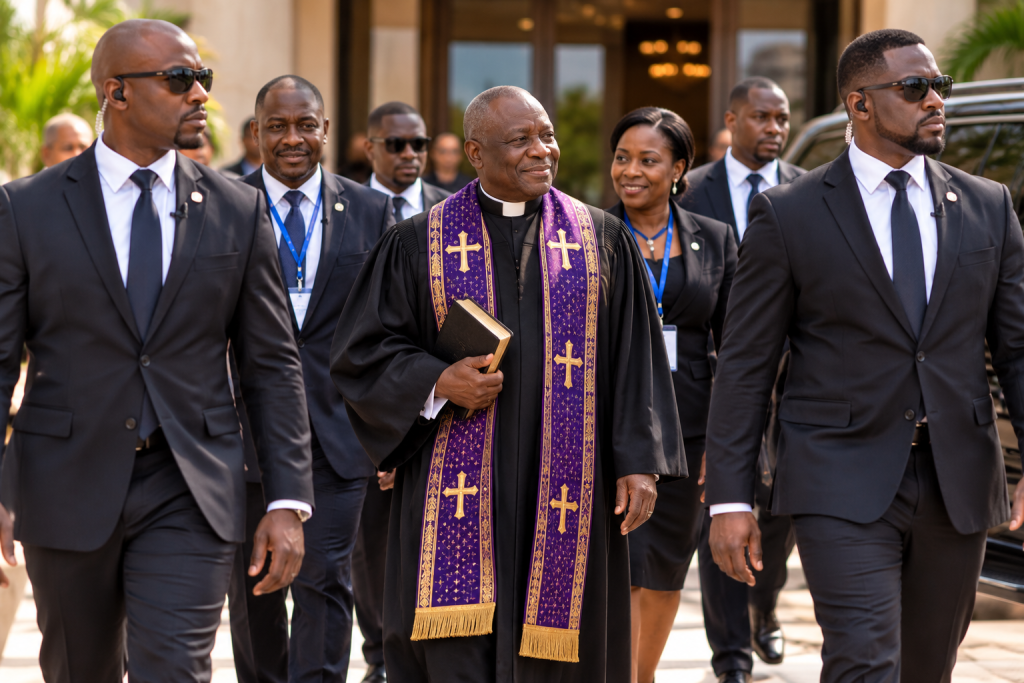
The argument made by some is that preaching in public transport matters because it gives ordinary people access to the gospel. If that is the argument, it invites a follow-up. How accessible have these same pastors made themselves to ordinary people? Can an ordinary member of the congregation get a conversation, a counselling session or a prayer with the person who leads the church? Or is access managed through layers of protocol officers and security, so that the shepherd is seen on a stage or a screen but rarely met?
I raise this knowing the other side of it. A public figure may have genuine security concerns, and every person is entitled to privacy. Living in a quiet, upmarket neighbourhood or travelling with security personnel does not make a pastor a hypocrite. The issue is the apparent contradiction when religious leaders demand unrestricted public access in the name of evangelism while their own arrangements make access to them difficult. Where that contradiction exists, it deserves an honest answer.
I should also be fair to the public preachers themselves. I have travelled on public transport and heard sermons delivered with such conviction and understanding that they stayed with me long after the journey ended. I have also met a different approach, one that seemed less concerned with preaching than with attracting attention or asking passengers for money.
I do not dismiss the gospel because someone misuses the opportunity to preach. Nor do I assume that every preacher who asks for support has bad intentions. Religious work needs resources, and those who give their time to it deserve fair consideration. But there is a difference between sharing a message that speaks to people’s lives and using a captive audience mainly to solicit money. Both realities exist at the same time, and the debate is poorer when we pretend only one of them does.
For that reason, I resist the attempt to frame the whole matter as a fight between the government and the gospel. Genuine evangelists do minister to ordinary people in buses and other public spaces, and their work deserves recognition. Others give the public legitimate reasons to question how the opportunity is used. A sensible conversation can hold both.
What I find hardest to follow is this. Some prominent pastors, who have placed considerable distance between themselves and ordinary people, have suddenly presented themselves as the defenders of those people’s access to the gospel. If they believe ordinary Ghanaians need spiritual guidance that urgently, they should reflect on how reachable their own ministries have become.
You cannot consistently invoke the struggles of ordinary people to defend your position without being willing to examine your own relationship with those people.
The gospel belongs to no celebrity pastor. The ordinary Christian does not need a famous preacher’s approval to meet Jesus Christ, and the duty to share the Word is not reserved for those with large congregations, impressive titles or elaborate protocol teams.
So where does that leave us? If the concern is truly the spread of the gospel, let us discuss how that mission can be pursued responsibly and effectively. Let us honour those who preach faithfully in public transport, and let us deal honestly with practices that inconvenience, exploit or endanger others. Let the Church challenge the state where the state is wrong. But let it also ask why some of its own people are leaving, and let it be willing to hear the answer.
The gospel calls us to examine ourselves before we condemn others. This controversy may be an opportunity to do exactly that. And above all, let us not confuse the interests of a pastor with the interests of Christianity. They are not always the same.