
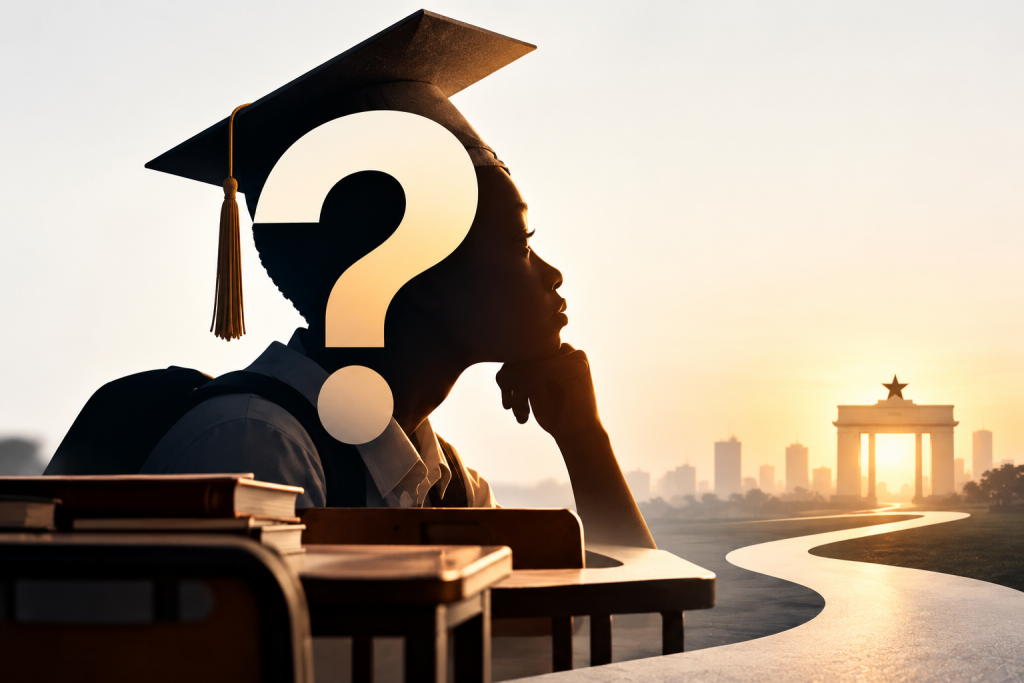
The Governance, Architecture and Politicisation of Education in Ghana
Ghana has never lacked educational policies. What we appear to lack is something more fundamental: a stable, coherent and continuously improving national education system.
This may sound like a provocative question, but it is one that we need to ask seriously.
Since the beginning of the Fourth Republic in 1992, Ghana has largely alternated between two major political parties. Each government has come with its own priorities, programmes, reforms and promises for education. Over the years, we have witnessed changes in the structure of basic education, secondary education and tertiary education. We have seen new policies introduced, old policies modified and, in some cases, policies reversed by succeeding governments.
There have been genuine achievements. Free Senior High School, launched in September 2017, is a case in point. Within six years, roughly 3.4 million students had passed through it, and by the 2023/2024 academic year, secondary school enrolment had climbed to around ninety-one per cent, with girls’ participation slightly ahead at ninety-three per cent. These are not small numbers, and they should not be dismissed.
The concern, however, is whether interventions of this kind form part of a carefully designed educational architecture that survives changes in government, or whether they remain forever attached to the party that introduced them, vulnerable to whatever the next administration decides to do with them.
That is where the real problem begins.
Education should be a national institution, not a political project
Education is too important to be treated as another area of political competition.
When one government introduces a programme, the conversation often becomes:
“We introduced this.”
The next government responds:
“But we introduced this.”
Then another government comes and says:
“We expanded what they started.”
And eventually, the education sector becomes a catalogue of political achievements rather than a system whose performance can be objectively measured.
We hear about the number of schools constructed, classrooms provided, computers distributed, textbooks supplied, teachers recruited and programmes introduced. All of these may be important.
But the harder questions are rarely asked with the same intensity.
What has actually changed in the learning outcomes of Ghanaian children? Are children leaving basic school with the literacy, numeracy, reasoning and problem-solving abilities they should have? Are secondary school graduates adequately prepared for university, technical education, employment, entrepreneurship and responsible citizenship? Are universities producing graduates whose skills correspond to the needs of the economy? Are we producing young people who can think independently, communicate effectively, use technology intelligently and solve problems? And perhaps most importantly, are we measuring these things consistently across governments?
If the answer is unclear, then we have a governance problem.
The architecture keeps changing
One of the clearest examples is the repeated alteration of the structure of education, and it is worth being specific about what that has actually cost us.
In 2007, following the recommendations of the Anamuah-Mensah Committee, the Kufuor government extended senior secondary education from three years to four. Two years later, in 2009, the incoming Mills government reversed the decision and returned the system to three years. The transition was not gentle. Because of how the reversal was managed, Ghana produced no senior high school graduating class at all in 2010, and by 2013 two full cohorts, the last four-year batch and the first accelerated three-year batch, were sitting the same examinations and competing for the same limited university placements in the same year. Whatever the merits of either duration, that particular transition was absorbed entirely by the students caught in the middle of it, not by the politicians who made the decision.
Beyond the length of secondary education, we have also changed terminology and renamed institutions. Secondary schools became senior high schools. There have been changes to curricula, examinations and admission arrangements, and periodic public debate about reversing course yet again, including a proposal in 2017 to seriously reconsider returning to a four-year model, which was never carried through.
Some reforms may have been necessary. Education systems must evolve. The problem is not change itself. The problem is change without institutional continuity, rigorous evaluation and a clear long-term national framework.
A serious education system should be able to say: this is where we are, this is where we want to be in ten, twenty or thirty years, this is how we intend to get there, these are the indicators by which we will measure progress, and this is what will remain regardless of which political party wins an election.
Instead, we often seem to operate on a four-year political cycle. A government introduces something. It becomes politically associated with that government. The opposition criticises it. Another government comes to power and modifies, replaces or reverses it.
The child sitting in the classroom, however, does not have a four-year political cycle. The child has one childhood, and as the 2010 graduation gap and the double cohort of 2013 remind us, that child bears the actual cost when we get the transition wrong.
The procurement question
There is another uncomfortable issue that we must be willing to discuss.
Education reforms require money. Infrastructure requires money. Textbooks, computers, furniture, uniforms, feeding programmes, school buses, laboratories and other interventions require procurement. There is nothing inherently wrong with government spending money on these things. In fact, government has a responsibility to invest in education.
But the governance question is whether procurement has sometimes become more visible than educational outcomes. We can celebrate the construction of hundreds of classrooms. But how many children are actually learning better because of those classrooms? We can celebrate the distribution of computers. But are the computers being used effectively? We can announce new textbooks. But are the books reaching the children who need them? We can build laboratories. But do students have the teachers, equipment and practical programmes required to use them? We can introduce a new curriculum. But what evidence tells us that the curriculum is producing better learning outcomes?
This is why every major education intervention should eventually face an independent review. What was promised? What was spent? What was delivered? What changed? Without those four questions, education policy can easily become an exercise in expenditure rather than transformation.
Politicians know what good education looks like
Perhaps the most painful part of this conversation is that many of our political leaders already know what a good education system looks like.
They know the schools that offer strong academic preparation. They know the value of small classes, competent teachers, libraries, laboratories, technology, discipline, extracurricular activities and well-designed curricula. Many understand international education standards. When resources permit, some send their own children abroad. Others choose expensive schools in Ghana offering foreign curricula and educational environments modelled on systems they trust.
There is nothing wrong with parents seeking the best education they can afford for their children. But a difficult question follows. If we know what works, why do we struggle to build it into the public education system for the children of Ghana? The child of the farmer in the village, the trader in Makola, the taxi driver in Accra, the teacher in Tamale and the public servant in Kumasi should not have to depend on the political party in power to receive a decent education. Education should be one of the areas where citizenship creates equality of opportunity.
We have policies. Do we have a system?
A system is more than a collection of programmes.
A proper national education system should have a clear architecture linking early childhood education, basic education, secondary education, technical and vocational education, teacher education and tertiary education. There should be continuity between the stages. The curriculum should develop progressively. Teacher preparation should correspond to what teachers are expected to teach. Assessment should measure genuine learning rather than encourage examination-driven memorisation. Technical and vocational education should have a respected place within the system. Universities should be connected to the needs of the economy without reducing higher education to job training alone. Most importantly, there should be an independent mechanism for evaluating whether the whole architecture is working.
That is governance.
What can we learn from elsewhere?
Ghana is certainly not the only country that has struggled with education reform. Other countries, including countries within Africa, have faced political changes, limited resources and competing national priorities.
Yet some have managed to build stronger institutional continuity. Countries such as Rwanda, Mauritius and Botswana, for example, have demonstrated different approaches to maintaining stronger national direction in education despite political changes. Outside Africa, countries such as Finland, Singapore and South Korea offer different models of long-term educational planning, teacher development, curriculum coherence and institutional accountability.
These countries are not perfect, and Ghana cannot simply copy another country’s education system. The lesson is elsewhere. They demonstrate that educational improvement becomes more sustainable when it is treated as a long-term national undertaking rather than the property of a particular government.
The question Ghana should therefore ask is not, “Which political party introduced Free SHS?” The question should be, “What educational architecture does Ghana need, and what evidence tells us that it is working?” The political party that introduces an important reform should receive credit. But the reform should then belong to Ghana.
Depoliticising the classroom
If we genuinely want educational transformation, Ghana needs a national education framework that enjoys broad political agreement.
Political parties should compete over how best to improve education, not over who gets to claim ownership of education. There should be certain fundamentals that no government can casually reverse. The structure of education should not change simply because the political party in power changes. Curriculum reforms should be based on evidence. Major interventions should undergo independent evaluation. Education expenditure should be subjected to rigorous value-for-money analysis. Learning outcomes should matter as much as infrastructure. Teacher quality should matter as much as teacher numbers. And every major reform should have a clearly defined timeline and measurable outcomes.
Perhaps Ghana needs an independent National Education Commission with sufficient authority, technical capacity and institutional independence to develop and monitor a long-term national education strategy. Such a body would not replace the Ministry of Education or the Ghana Education Service. Its role would be to protect the long-term architecture of education from short-term political disruption.
Where do we go from here?
This is not an argument against government. It is an argument for better governance of government.
We should stop measuring educational progress principally by what a government has introduced and start measuring it by what Ghanaian children have learned. We should stop asking only how many schools have been built and ask whether children are receiving a better education. We should stop celebrating programmes merely because they are new and ask whether they are better. We should stop changing educational structures without first establishing what the previous structure achieved or failed to achieve. And we should stop treating education as a political trophy.
Ghana does not need another education reform simply because a new government has arrived. Ghana needs a national education system that is strong enough to survive governments.
For more than three decades of the Fourth Republic, we have had different governments, different ministers, different policies and different educational interventions. What we have not yet demonstrated convincingly is that these changes are part of one carefully governed national journey.
That is the question we must confront. Do we actually have an education system, or do we have successive governments running successive education programmes?
Until we answer that question honestly, we may continue building schools without building a system, changing curricula without changing outcomes, spending more money without knowing precisely what it has achieved, and producing political narratives about education without producing the educational results Ghana needs.
The children should not have to wait for us to get the governance of education right. They only get one chance at childhood. And Ghana gets only one generation at a time.