
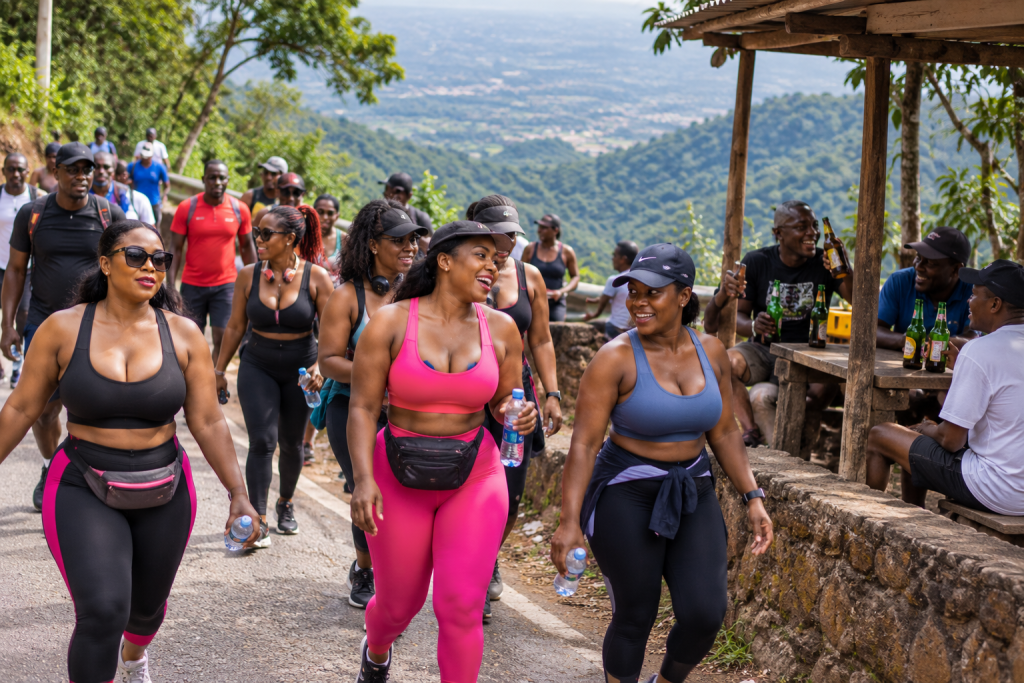
Fitness, fashion, kenkey and a surprisingly serious economy on the Ayi Mensah to Peduase road
There is a special kind of person who wakes up on a Saturday morning in Ghana and says, “Today, I will take care of my body.” And then there is everyone else on the Ayi Mensah to Peduase route, who woke up and said, “Today, somebody must see me.”
The Aburi mountain road has quietly turned from a fitness trail into one of Ghana’s most multipurpose open-air institutions. It is a gym, a runway, a matchmaking service, a chop bar, a drinking spot and, occasionally, a place where actual walking happens.
The 5 AM truth
Let us begin with the genuine walkers. They are the dedicated souls in proper trainers and soaked headbands, wearing the haunted expression of people who have chosen suffering voluntarily. They arrived at 5 AM sharp and greet each other with nods of mutual respect. They are here for the heart; the lungs and the cholesterol report they are terrified to collect on Monday.
They are also, bless them, the minority. Like teetotallers at a wedding, they came for one thing and are watching everyone else enjoy something else entirely.
The runway brigade
Enter the fashion contingent. Somewhere along the line, someone decided that the mountain road was an extension of Accra Fashion Week, and nobody had the courage to correct them.
You will see a full face of makeup at 6:30 AM: foundation, contour, and winged eyeliner sharp enough to open a sachet of water. Scientists have not yet explained how this survives three kilometres of uphill perspiration, but the theories range from industrial-grade primer to plain spiritual covering.
This is not a health walk. It is a photoshoot with cardiovascular consequences.
The fragrance department
Then there is the olfactory experience. Somewhere between Ayi Mensah and the first bend, you move from fresh mountain air into what can only be described as a duty-free shop in motion.
The tragedy is the mathematics. Perfume plus sweat does not equal attraction. It equals a chemical incident. But nobody has the heart to say so.
The CMB division, looking for love
Ah, yes. The real marketplace of the mountain. For a certain group, “health walk” is only the cover story, the registered business name, if you like. The actual business is observation.
Marriage counsellors should hold their sessions on this road. The market is already gathered.
The breakfast betrayal
Now we reach the philosophical crisis of the walk: people who came to burn calories and are committing calorie fraud instead.
There, at the roadside, before the sun has cleared the hills, a man in full athletic wear, headband, armband and the whole ministry of fitness, stands over a ball of kenkey like a priest at an altar. It is 6:45 AM. Hot pepper, fried fish, the complete morning constitution. He has walked four hundred metres, conquered nothing, and consumed enough carbohydrates to power a taxi from Madina to Nkawkaw.
And it is never a small portion. This is not a taste. It is a full thanksgiving service with shito.
Meanwhile, his friend, the one who said “we are doing this for our health”, is holding a beer. At 7 AM. On a Saturday. On a mountain. Sir, the sun has not clocked in yet and you are already arguing loudly about the Black Stars’ formation. The bars in town have not even opened, and yet here, at altitude, the pub is fully operational.
The logic is fascinating: “We Walk so that we can eat.” No, my brother. You walked from your car to the kenkey seller. That is not exercise. That is a commute with seasoning.
But who can blame them? The kenkey on that road is seasoned with something spiritual. People have driven all the way from East Legon “for the walk” and never made it past the first food vendor. Their entire fitness plan collapses at the smell of fried fish. They came to shed weight and left carrying Tupperware.
The arrival committee, short-cut division
And then there are the elite, the strategic geniuses, the ones who understood the assignment differently from everybody else.
While you are panting up the mountain, sweating through your borrowed motivation and questioning your life choices at kilometre two, somewhere at the finish point, where the walk is supposed to end, a full headquarters has been established.
These are the people who drove. Directly. Past all of you. They watched you from the car window, horn slightly tempted, as they cruised to the summit with the air conditioning on and gospel music playing.
By the time you arrive, chest heaving and dignity partially restored, ready to announce “I made it”, they are already seated. Plastic chairs. Table arranged. Drinks sweating in the morning chill. A full conversation in progress about politics, football and somebody’s nephew who refuses to marry.
“Ahhh, you have arrived! We have been waiting for you people since! Come and sit down, take something.”
Take something? Take WHAT? I have just climbed a mountain on foot and you are offering me a cold drink and fried yam while seated in a chair that has been warm for forty-five minutes?
And the painful part is that they will still claim the walk. “Oh yes, we did the walk o, well, we did a walk, from the car park to here. It was far.”
The audacity is breathtaking. They have turned the finish line into a lounge. The health walk has a VIP section, and they are in it, hydrated, rested and completely unbothered, while the rest of us arrive looking like evidence.
Some do not even pretend. They did not bring walking shoes. They brought chairs. One man reportedly brings his own tablecloth. A tablecloth. On a mountain. For a walk he did not walk.
Now the serious part: who gets paid on Saturday?
Having laughed at the mountain, let us give it some respect. Behind the jokes sits an economy that deserves to be taken seriously.
Count what changes hands before 9 AM. The kenkey and fried fish. The waakye. The sachet and bottled water. The fried yam, the roasted plantain, the boiled eggs, the fruit. The trainers, headbands and leggings bought for the occasion. The taxi or ride-hailing fare to the foot of the hill. The fuel for those who drove straight to the top. The plastic chairs and tables, which someone owns, transports and sets up every week. The photographer, the aerobics instructor, the phone-charging boy. Every item on that list is somebody’s income.
I have not found an official count of Saturday walkers or what they spend, so I will not invent one. But the shape of the economy is easy to see, because it mirrors the national picture. The Ghana Statistical Service has said the informal sector provides about eight in ten jobs and contributes roughly 27 percent of GDP. Its first Integrated Business Establishment Survey, reported in March 2026, counted about 2.6 million informal businesses operating in the open or on the move. Two thirds of the open space businesses sell food and drink, and women make up about eight in ten of their operators. Many put in long days: about 64 percent work at least six days a week.
That is the person selling you kenkey at 6:45 AM. She is probably awake before you, and she is likely a woman, with a business that has been there longer than your gym membership. The GSS found that nearly a third of such operators earn GH¢100 or less a day. For many of them, a busy Saturday is one of the better days of the week.
The chain does not stop at the roadside. The fish seller buys from a fisherman or a wholesaler. The kenkey comes from a maize farmer, a miller and a market woman. The yam travels from the farm by a transporter. When the walker buys a plate of fried yam, money moves back along that chain to a farmer somewhere in the country.
Add the larger picture. The Aburi hills, at about 450 metres above sea level, are a cooler retreat from the coast and already a known destination, with the botanical gardens (established in 1890) and the Peduase Lodge nearby. A Saturday walk is a cheap and regular way to bring Accra residents up the hill every week of the year, not just on public holidays. They buy things, they notice the place and some may well return on another day with the family.
All this suggests that the mountain deserves better than benign neglect. Local assemblies, the Ghana Tourism Authority and the Ghana Health Service could work with vendors to organise the weekly crowd: clean public toilets, proper refuse collection (a Saturday crowd produces a great deal of sachet water plastic), safe parking, road safety for walkers on the N4 and the hill roads, basic vendor registration and designated stalls. A healthier walk, with fruit, water and lighter food on offer alongside the kenkey, would help both the walkers and the sellers. Properly managed, the hill could be a model of how a health habit, a tourist draw and a street economy can feed one another. Left alone, it will stay what it is today: popular, profitable for many and slightly chaotic.
The descent of wisdom
By 9 AM, it is over. The genuine walkers are exhilarated and already planning next week. The fashion models have discovered which fabrics do not forgive perspiration. The perfume wearers have learned a hard lesson about aerosol thermodynamics. The romantics have collected three numbers and blocked two people. The shoppers cannot feel their arms. The kenkey eaters have entered a food coma and are being carried to their cars. And the Arrival Committee is on its third round, wondering aloud why everyone else looks so tired. “Maybe you people should walk more.”
And the mountain? The mountain has seen it all. It has watched generations arrive with sneakers and hidden agendas, with waist trainers and secret hopes, with six-packs, both cans and abdominals, and with plastic chairs for journeys never taken.
That is the true genius of the Aburi Saturday Walk. It promises health, and it delivers, just not always the kind you expected. Your cholesterol may not have moved, but your social life got a workout. Your abs stayed hidden, but your intentions were fully visible. Somebody’s business did well, and a family in a village or a market got paid. You may not have reached the top on foot, but you reached somewhere, and in Ghana that is more than enough.
So, lace up. Splash on the perfume. Iron the leggings. Charge the phone for the content. Skip the first bend if you must and drive straight to the top, where there will be a cold drink and a warm chair waiting. Just remember to buy something from the woman at the roadside, and, if you can, take a few real steps while you are there.
The mountain is waiting. And it is very, very amused.