
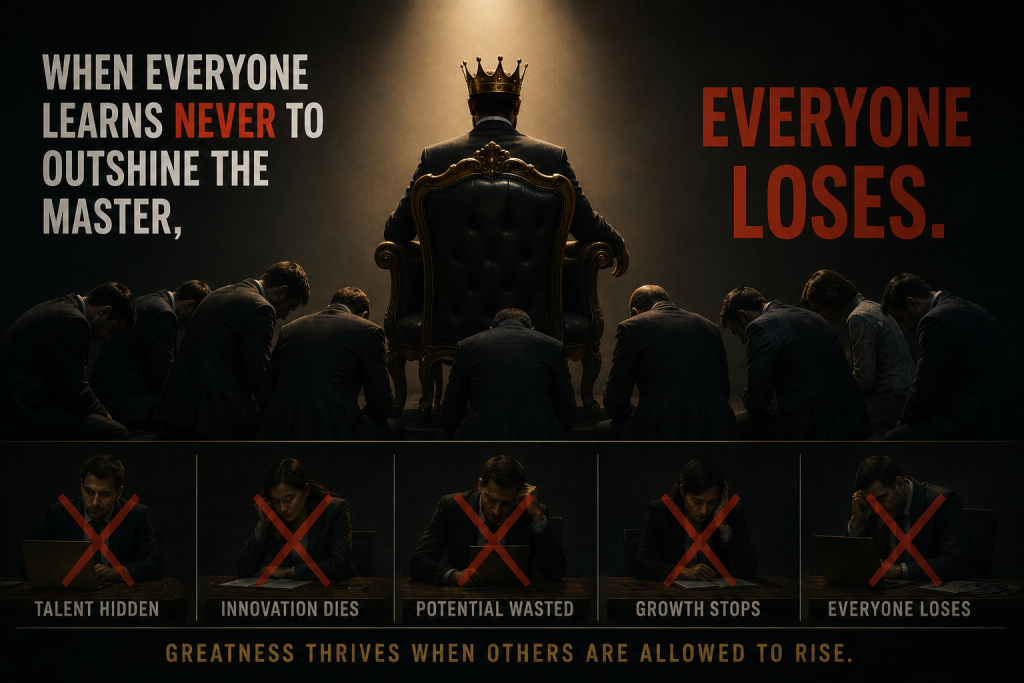
I have already written about the wisdom in Robert Greene’s first law of power, the counsel to avoid making a superior feel threatened by your talent. There is genuine strategic value in restraint, and I still believe that. But there is a version of this principle that worries me, not the individual practising discretion in a difficult season, but an entire organisation, or an entire culture, quietly adopting it as a way of life.
Because a law that makes sense for one person managing one insecure leader becomes something far more dangerous when it becomes the unspoken rule everyone lives by.
Picture an organisation where every capable person has learned the same lesson. Say less than you know. Let the leader’s ideas go unchallenged, even the poor ones. Perform admiration you do not feel. Time your competence carefully so it never outshines the person above you. Multiply that lesson across an entire staff, an entire faculty, an entire boardroom, and you no longer have a team of talented people practising occasional tact. You have a room full of pretenders, each one managing the leader’s ego instead of doing the work the institution actually needs.
This is where I part ways with an unqualified version of the law.
An organisation full of people protecting a superior’s fragile confidence is an organisation that has quietly agreed to stop telling the truth. The best idea in the room goes unspoken because the person who thought of it knows better than to let it outshine the leader’s own. The obvious flaw in a decision goes unmentioned because pointing it out would embarrass someone whose ego the whole room has learned to protect. Meetings become theatre. Everyone performs agreement. Nobody is actually thinking out loud anymore, because thinking out loud is now understood to be dangerous.
We all lose when we feed a leader’s ego instead of feeding the mission.
I think of the old story of the emperor who paraded through his city in clothes that did not exist, surrounded by advisers too afraid to tell him the truth, each one convinced that everyone else could see something he could not. It is a children’s story, but it describes something real about what happens inside institutions built on flattery. Everyone privately knows the truth. Nobody says it. The emperor keeps walking, more exposed with every step, precisely because the people closest to him decided that his comfort mattered more than his correction.
That is the real cost of turning never outshine the master into a culture rather than an occasional tactic. It does not merely limit individuals. It starves the organisation of its own best thinking, at exactly the moment that thinking is needed most.
There is also a slower, quieter cost, the one that shows up in the people themselves rather than in any single bad decision. A talented person who spends years dimming their own competence to avoid outshining a superior does not simply lose visibility. They begin to lose the habit of full effort. Excellence, unpractised for long enough, atrophies. We do not only fail our leaders when we become pretenders. We fail ourselves, one small act of self-editing at a time, until the person capable of brilliance has quietly forgotten how.
None of this means every individual instance of discretion is wrong. There is still a place for reading a room, for choosing your moment, for protecting a relationship you may need later. I have not abandoned that view. What I am arguing against is different: the moment restraint stops being a tool you use deliberately and becomes the permanent temperature of an entire institution, something has gone badly wrong, and it is rarely the talented people who are to blame.
The real responsibility here sits with leadership, not with those beneath it. A leader who cannot tolerate a capable colleague, who needs every room to confirm his own brilliance before he will listen to anything useful in it, is not building an institution. He is building a mirror, and mirrors do not solve problems. The healthiest leaders I have known are the opposite of insecure. They actively look for people who might outshine them in a particular skill, because they understand that an organisation full of quietly brilliant people who are actually permitted to be brilliant will always outperform one built around a single fragile ego at the top.
So yes, there is wisdom in tact. There is wisdom in knowing when to hold your tongue and when to let a leader take the credit that keeps the peace. But if an entire institution has organised itself around protecting one person’s insecurity, the problem was never really about talent outshining anyone. The problem is that we built a culture where the truth had become more dangerous to speak than to withhold, and no institution, no matter how carefully everyone protects the person at the top of it, can survive that indefinitely.
Never outshine the master, perhaps, in the moment that calls for it. But never build a whole culture where everyone has learned to disappear.