
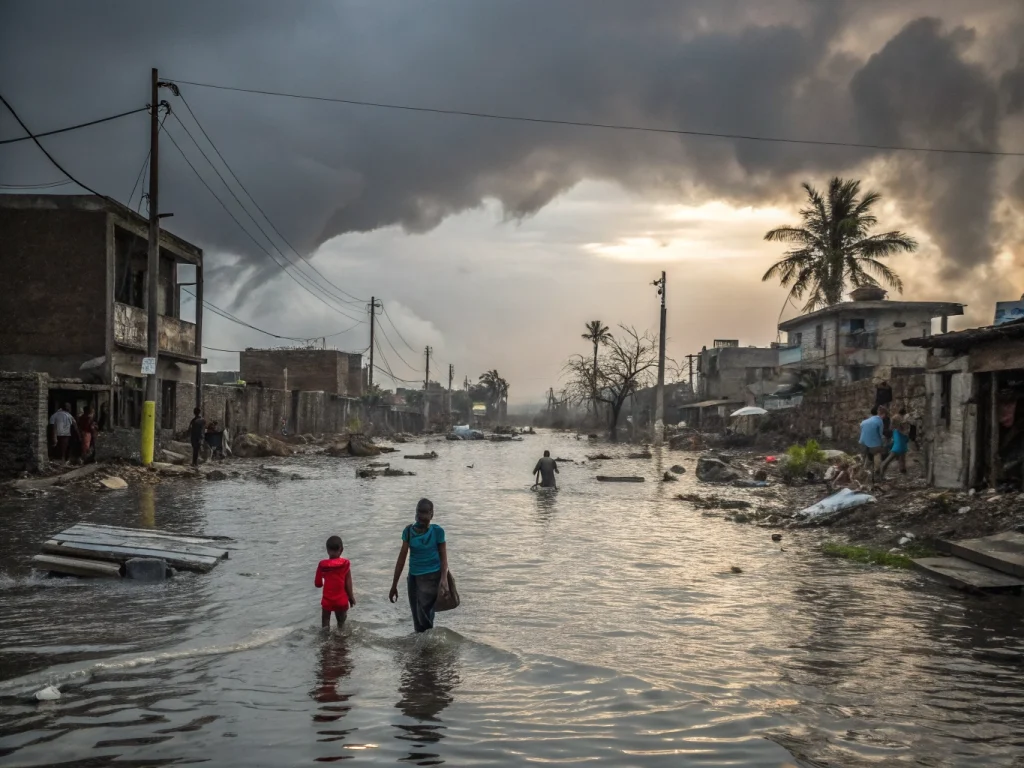
The clouds gather with a punctuality that our institutions have never managed to replicate. The drains choke. The streets dissolve into rivers of dark, refuse-laden water. Families wade through the consequences of decisions that were never made and policies that were written, celebrated, and then quietly shelved. And we the long-suffering, endlessly patient citizens of this republic do what we have perfected across generations: we lament. We photograph the devastation. We share it. We weep. And then, when the waters recede and the mud dries into a fine, forgiving dust, we forget. Until next year.
This is not a new story. It was the story sixty-nine years ago when independence was still warm with promise. It was the story thirty years ago, twenty years ago, a decade ago, five years ago, and with breathtaking fidelity it was the story yesterday. The cast changes; the tragedy does not. The floods arrive on schedule, the grievances are rehearsed with impressive emotional authenticity, and the national conversation performs its familiar choreography: Who caused it? Who should fix it? And perhaps most revealing of all who even has the moral standing to speak about it?
That last question is the most dangerous one, because it is the one we use to silence each other. It is the rhetorical trapdoor through which accountability disappears. And disappear it does, every single year, with the efficiency of a government contractor who has already been paid.
There is, of course, an explanation always at hand. Perhaps this is simply the African condition, an immutable feature of the landscape, like the harmattan or the heat. Perhaps we should accept it. Perhaps, more fervently still, we should pray. God, after all, is infinitely patient with our inaction, which makes Him an ideal national governance partner. And so, the prayers rise with the floodwaters, earnest and achingly sincere, directed toward a heaven that has one gently suspect been waiting for us to also fix our drainage.
But then there is Rwanda.
Rwanda is, inconveniently for this particular theology of helplessness, also in Africa. Rwanda lost nearly a million people in one hundred days and somehow through the unglamorous, unspiritual, deeply unfashionable work of governance, accountability, and institutional discipline rebuilt itself into a nation where streets are clean, policies are enforced, and flooding, while not unknown, is not an annual ritual of national self-pity. Rwanda does not appear to have received a special continental exemption from the laws of cause and effect. It simply chose, at enormous cost and with formidable seriousness, to govern itself.
But we are Ghana, and we have our own arrangements.
Our arrangements include policy makers who speak with tremendous authority at conferences, workshops, and training sessions, many of them held abroad, where the hotels are finer and the per diem more generous. Our arrangements include institutions that perpetually require more power, larger budgets, and broader mandates in order to develop policies that will be launched with great ceremony, photographed extensively, and then enforced with the same rigour with which we enforce traffic lights after midnight. Our arrangements include a political culture so thoroughly marinated in the rhetoric of solutions that the actual delivery of solutions would feel, at this point, almost disruptive.
How did we arrive here? We arrived here because we discovered, some time ago, that the acceptance of excuses is far less exhausting than the demand for results. We arrived here because we permitted it quietly, incrementally, and with the best of intentions.
Consider the settlement. A piece of land, often a floodplain or a riverbank, is occupied by people who are poor and who need somewhere to live. The humane instinct is to allow them to settle. It is also the humane instinct to provide them with water, sanitation, drainage, and the basic infrastructure of dignified existence. We reliably perform the first act and then entirely abandon the second. And so, a community grows, informal, unserviced, invisible to municipal planning and the people within it do what any rational human being does in the absence of refuse collection: they manage their waste as best they can. The gutters receive what the absent infrastructure cannot accommodate. The waterways, long since built over or sold off to developers with the right connections, are no longer there to carry anything anywhere. And we are surprised.
We are surprised, moreover, by gutters that are too shallow to carry the volume of water a tropical downpour delivers, gutters that were presumably designed by engineers who had never encountered a tropical downpour, or possibly by someone’s nephew. We are surprised when structures erected directly across water channels obstruct the flow of water, a phenomenon that even a child studying basic hydrology would have anticipated. We are surprised when the rubbish collected from flooded gutters because we do, periodically, clean them, is deposited on the pavement beside those same gutters, where it sits for three days before the next rain returns it, with compound interest, to exactly where it was. This is not a drainage problem. This is a philosophical commitment to the illusion of action.
And there are the roads. Money allocated for road construction migrates, with an agility our infrastructure never achieves, toward healthcare costs incurred when flooding spreads disease through communities that have no toilets and no clean water. It is a remarkable system, when you study it with sufficient detachment: we underfund prevention so comprehensively that we must perpetually overspend on cure, and we call this governance.
The grief that accompanies each flood season is real. The anger is real. The exhaustion of the woman who watched her children’s schoolbooks dissolve in brown water is real, and it deserves more than a paragraph in a newspaper and a ministerial press release expressing concern. What is not real, what has never been real is our collective willingness to insist that things change. We have confused lamentation with accountability. We have mistaken the noise of outrage for the work of reform. We have, in short, given excuses and taken excuses, season after season, until the exchange has become so natural that we no longer notice we are doing it.
Next year, the rains will come again. The gutters will fill with the same refuse deposited by the same hands that earlier cleared them, in the same communities still awaiting the same water supply and the same sanitation promised in the same manifesto. The same photographs will circulate. The same voices will cry out. The same officials will express the same concern. And we will, unless something fundamental shifts in our national conscience, perform the same grief for the same cameras and then return, damp and dignified, to doing absolutely nothing.
Rwanda is still in Africa. The question is whether we are still serious about being in Ghana.